We dream of a world where people are not bought or sold but right now an estimated 40 million people are currently trapped in modern slavery.
Human Trafficking
It is defined by the United Nations Office on Drugs and Crime as:
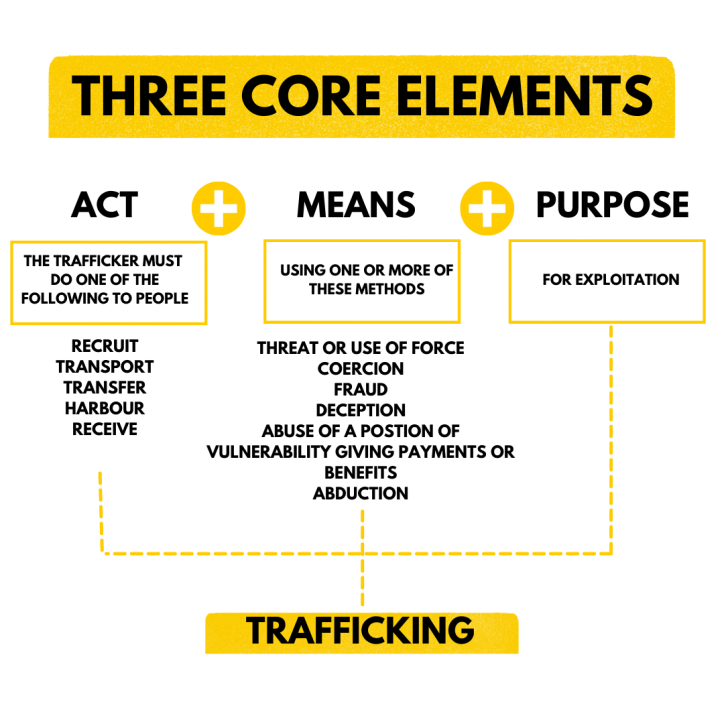
The Act of recruitment, transportation, transfer, harbouring or receipt of persons, by means of the threat or use of force or other forms of coercion, of abduction, of fraud, of deception, of the abuse of power or of a position of vulnerability or of the giving or receiving of payments or benefits to achieve the consent of a person having control over another person, for the purpose of exploitation.
This means human trafficking is made up of three elements:
- Movement or recruitment by
- Deception or coercion for
- The purpose of exploitation
Modern Slavery
This acts as an umbrella term, which covers a number of human rights abuses, of which human trafficking is one.
It is mainly defined by the 1956 UN supplementary convention which says:
…debt bondage, serfdom, forced marriage and the delivery of a child for the exploitation of that child are all slavery-like practices and require criminalisation and abolishment…
Modern slavery encompasses:
• Slavery
• Human trafficking
• Servitude
• Forced or compulsory labour
Traffickers and slave masters use whatever means they have at their disposal to coerce, deceive and force individuals into a life of abuse, servitude, and inhumane treatment.
Scale of the Issue:
Given the hidden nature of human trafficking, it is almost impossible to understand the full scope and scale of the issue.
While the true scale of human trafficking and modern slavery is an unknown, there are an estimated 49.6 million victims trapped in modern-day slavery.
Of these:
• 27.6 million are exploited for labour
• 17.3 million are in forced marriage
• 12% of all those in forced labour are children
Breakdown
Human trafficking and modern slavery do not discriminate; they affect all genders and all ages.
By Gender
- 71% of trafficking victims around the world are women and girls and 29% are men and boys.
*N.B due to a lack of data we cannot report on the break down impacting other genders at this time.
By Age
30.2 million victims (75%) are aged 18 or older, with the number of children under the age of 18 estimated at 10.1 million (25%).
- 37% of victims of trafficking in forced marriage were children.
- 21% of victims of sexual exploitation were children.
By Industry
Forced labour takes place in many different industries. While every industry is susceptible, those highlighted in the report are broken down as follows:
- 16 million (64%) forced labour victims to work in domestic work, construction, or agriculture.
- 4.8 million (19%) persons in forced sexual exploitation.
- 4 million (16%) persons in forced labour imposed by state authorities.
Debt Bondage
Debt bondage affected half of all victims of forced labour imposed by private actors. Debt bondage is used as a method of control and prevents trafficking victims from escaping.
Learn about the Types of Exploitation
You now know what human trafficking is and the scale of the issue – next, learn about the different forms this crime takes around the world.
Visit Traffik Analysis Hub
Trafficking continuously changes. For a real-time global picture of how trafficking is changing, visit the largest data set on human trafficking: